Scaling recipes (and why salt doesn't double)
How recipes.im handles serving size scaling — and why some ingredients are intentionally fixed, marked with an orange chef hat.
Doubling a chocolate chip cookie recipe shouldn't double the salt. Halving a soup shouldn't halve the cooking time. Scaling sounds like simple multiplication; it isn't. We try to do the obvious things and hold back where the math would mislead.
How to scale
Tap the serving count at the top of any recipe and pick a new number. Every quantity re-renders immediately. Tap Reset to go back to the original.
You can also set a default servings preference for your household — every recipe opens to that number out of the gate, so you stop scaling "to 2" every single time.
What scales linearly
- Most ingredients — flour, oil, vegetables, meat, dairy.
- Tablespoons, cups, milliliters, grams — all multiply by the scale factor and re-render in the cleanest unit.
- Counts that can be split —
0.5 chicken breast,1.5 lemons. We assume you can halve or quarter these.
What rounds to whole numbers
Some ingredients are integer-only in a real kitchen. Eggs, garlic cloves, bay leaves, star anise, cinnamon sticks. If the math says 0.38 egg, we round up to 1 egg. If it says 2.4 eggs, we round to 2. The full list lives in the parser; you can't add to it from the app.
What never scales
- Cooking times. Doubling a recipe doesn't double the bake time — that's geometry and thermal physics, not arithmetic. The cook decides whether the bigger tray needs five extra minutes.
- Cookware. Doubling doesn't add a second pan or a bigger Dutch oven. The cook decides what to scale up.
- Ingredients marked with an orange chef hat — see below.
The chef hat: non-scaling ingredients
Look for the orange on an ingredient row. It marks a quantity that's intentionally not scaled — the model decided this ingredient should hold roughly steady regardless of serving size.
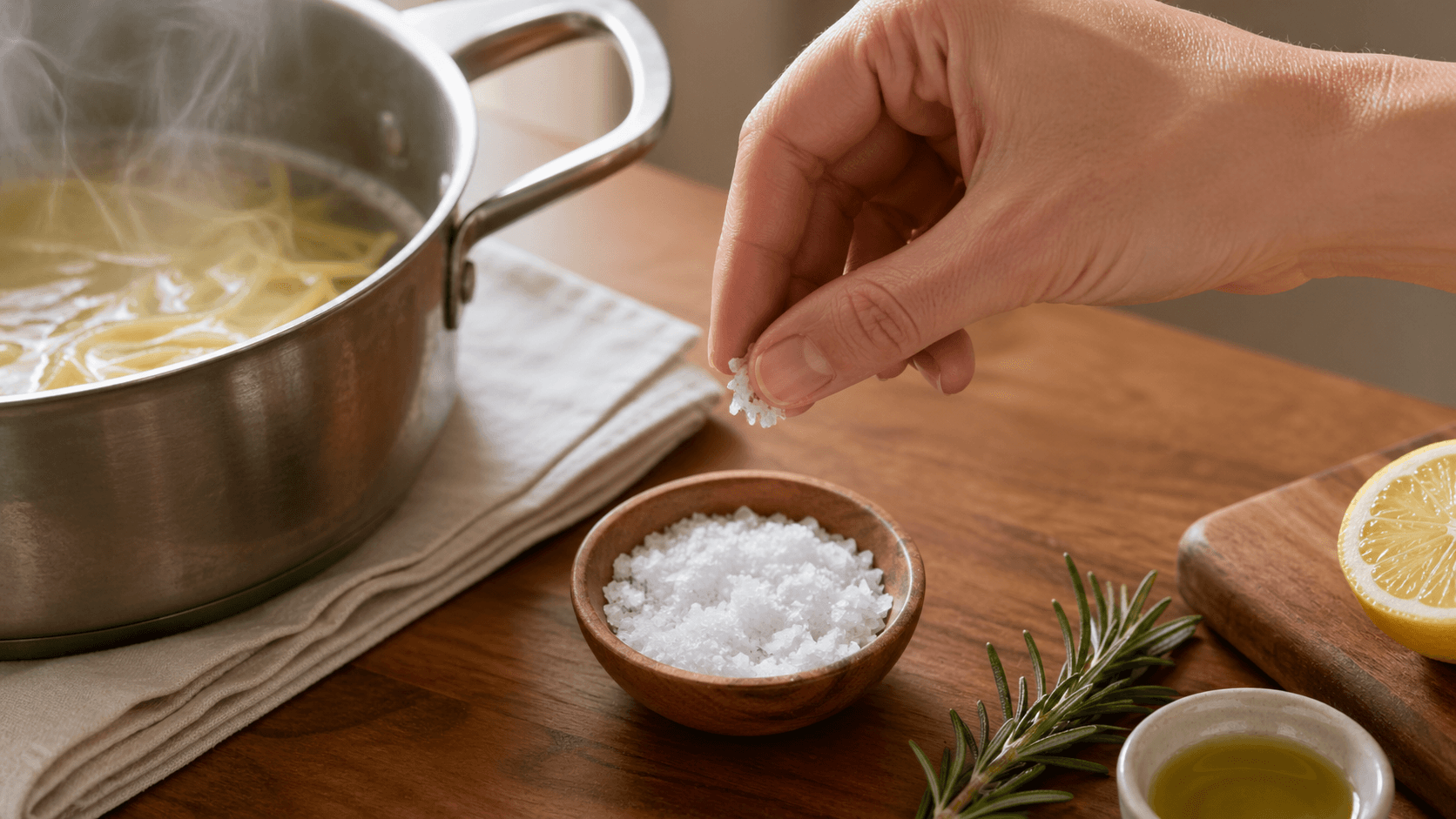
The classic case is salt. "1 tsp salt" works for 4 servings of pasta sauce. It also works for 8. It mostly works for 12. Scale it up linearly to 3 tsp salt for triple servings and the dish is inedible. Same logic for:
- Salt, sugar, MSG — anything that seasons by taste rather than by ratio.
- Baking powder, baking soda, yeast — leavening that depends on the chemistry of one batch, not on how many people will eat it.
- Extracts, vanilla, almond essence — flavor backbones that don't proportionally compound.
- Spices in trace amounts (
¼ tsp cayenne) — these are taste-tuners.
We mark these at import time, when we generate the .cook file. The model is instructed to write @salt{=1%tsp} (note the =) for any ingredient where doubling the recipe shouldn't double the amount. The app reads that marker and pins the quantity.
Counts vs measurements
When an ingredient has a count (2 onions) we pluralize correctly as you scale — 1 onion, 2 onions, ½ onion. Mass nouns don't pluralize: 2 cups of flour, never flours. Plurale tantum stay plural: 2 stalks of chives, not 1 chive.
Edge cases worth knowing
- Mixed-fraction inputs like
1 ¼ cupsare recovered correctly even when the underlying parser stores them as text. - Above 1 kg, weights snap to 50 g increments so a tripled recipe gives you
1.5 kg, not1.487 kg. - Above 1 L, liquids switch to liters and stop offering a kitchen-scale weight option (you can weigh half a liter of milk; you can't weigh two liters).
Related guides
How recipes.im handles cups vs grams, US vs Australian tablespoons, and when we weigh solids vs measure them by volume.
Categorization, quantity merging, pluralization, and why your shopping list keeps cups separate from grams.
How recipes.im households work — invite codes, shared libraries, and the per-household units-and-conversion settings that drive scaling and grocery aggregation.